The Strongest Cockroach Killer in the UAE: An Honest Comparison
Watch the video guide
It is the most searched question in this category, and it has a frustrating answer: "strongest" is the wrong measure.
Toxicity is easy. Any hardware shop in the UAE sells something that will kill a cockroach on contact. That is not the problem. The problem is that the cockroach you see is a small fraction of the ones you have, and killing the visible ones changes nothing about the colony breeding behind your cabinets.
What actually eliminates an infestation is a product that reaches the insects you cannot see. By that measure, the ranking looks very different.
The comparison
| Method | Reaches the nest? | Time to control |
|---|---|---|
| Non-repellent gel bait | Yes — carried back by the insect | 4–8 weeks (clear drop in 1–2) |
| Aerosol / pyrethroid spray | No — kills what it touches | Minutes, then rebound |
| Boric acid powder | Partly — if they walk through and groom | Weeks |
| Sticky traps | No — monitoring tool | Never alone |
| Ultrasonic repellers | No | No evidence of effect |
| Professional treatment | Yes — usually the same baits | 4–8 weeks (clear drop in 1–2) |
Why sprays feel strongest and perform worst
A spray gives you the most satisfying feedback in pest control: the insect dies while you watch. That feedback is exactly what misleads people.
Pyrethroid sprays are repellent. Cockroaches detect the residue and avoid the treated surface. So the ones that survive — which is most of them, because they were never in the open — simply relocate deeper into the structure, into wall voids and neighbouring units. The visible population drops, then returns larger, and now it is distributed across places you cannot spray.
There is a worse consequence, and it is the single most common reason a genuine gel bait fails: spray residue near gel makes cockroaches avoid the bait too. They will not cross a treated surface to reach it. If you have sprayed recently, gel placed in that area does nothing.
Why gel bait wins on the measure that matters
A non-repellent gel does not announce itself. The cockroach feeds willingly, returns to the harbourage, and dies there. Others feed on the droppings and the carcass, which is how a single feeding event reaches insects that never touched your dot — the secondary and tertiary effect.
That mechanism is the whole reason gel outperforms products that are far more acutely toxic. You are not trying to kill an insect. You are trying to deliver a dose into a population you cannot reach.
The two gels worth comparing
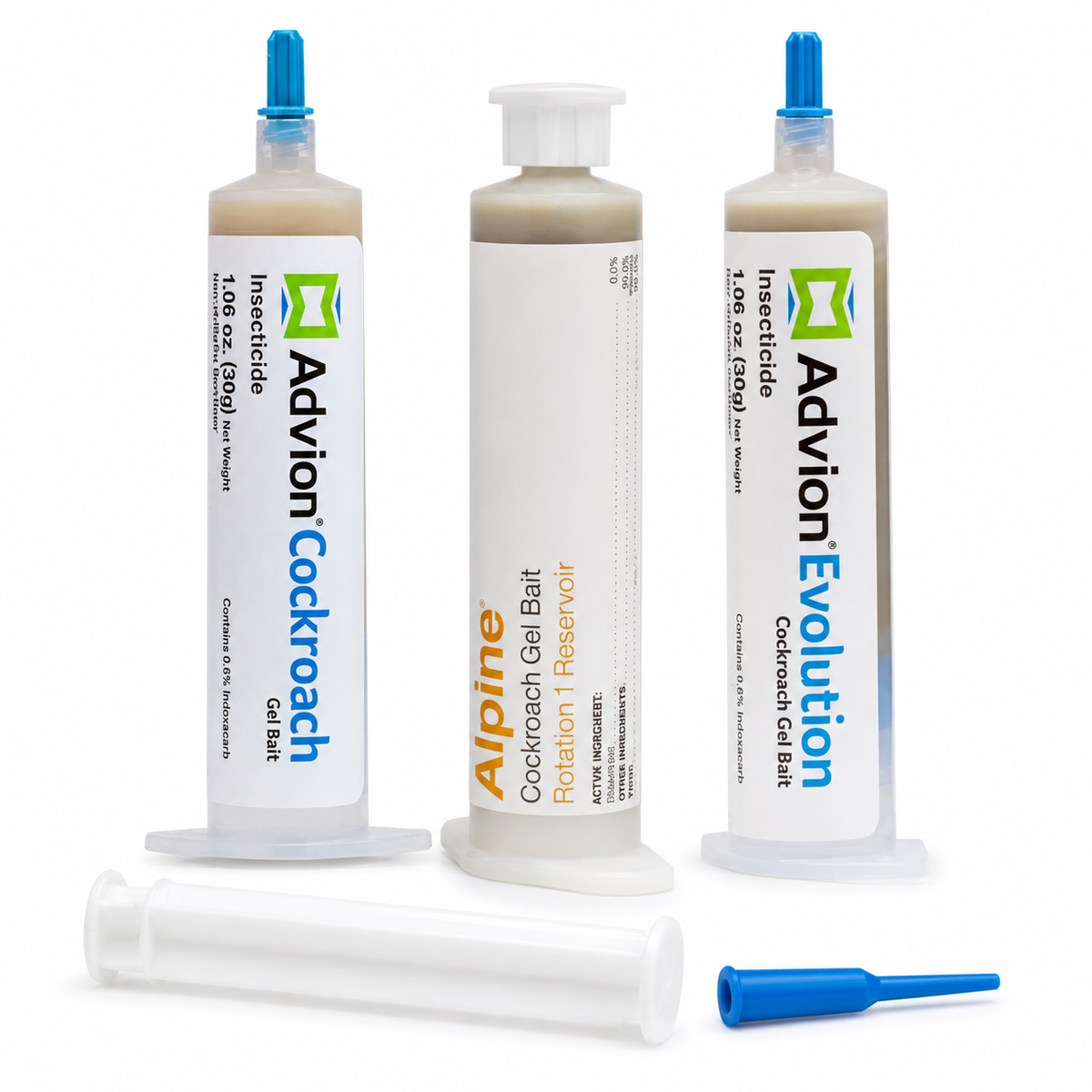
Both are professional-grade, both are non-repellent, and they use different chemistry — which matters more than most people realise.
Advion Cockroach Gel Bait — indoxacarb 0.6% (Syngenta)
Indoxacarb is a pro-insecticide: it converts to its active form inside the insect. Highly palatable matrix, strong performance against German cockroaches including bait-averse strains. This is the one most people mean by "the American gel".
Alpine Cockroach Gel Bait — dinotefuran (BASF)
A different mode of action entirely. Useful in its own right, and more useful still as the second product in a rotation.
The thing that actually beats any single product
Cockroaches develop bait aversion. Use one formulation continuously and, over months, the population can stop finding it attractive — not because the poison stopped working, but because they stopped eating it.
This is why professionals rotate the active ingredient roughly every three months. Rotation, not brute strength, is what keeps a property clear long-term. We have written the protocol out in full in the 3-month rotation program.
So the honest answer to "what is strongest": a non-repellent bait the cockroaches will eat, placed where they actually live, with the active ingredient changed periodically. No single tube is the answer.
What to use for your situation
- A few roaches in the kitchen. One tube of gel, correctly placed. Nothing else.
- Heavy infestation, several rooms. Gel at the higher dosing rate (3–5 dots per 3 metres), plus sticky traps to monitor where activity is concentrated.
- It came back after a few months. Rotate to a different active ingredient rather than reapplying the same one.
- You share walls and they keep returning. This is a building-level problem. Gel in your unit will hold it down but will not end it — the neighbouring units need treating too, and that is a conversation with building management.
- Food premises or a restaurant. Different rules and different documentation requirements — see the restaurant guide.
Three mistakes that neutralise any product
Spraying near the bait. Covered above, and worth repeating because it accounts for most failures.
One large blob instead of many small dots. Cockroaches feed at the edges of a deposit. Many small dots give far more feeding surface than one big one, and reach more of the population.
Applying in the open. Dots belong inside cracks, cabinet hinges, pipe gaps, the underside of the sink, the motor compartment of the fridge. A dot on a visible countertop is a dot nothing will eat.
The short version
Nothing on the shelf is "strongest" in a way that helps you. What works is a non-repellent gel bait, placed correctly, left alone for two weeks, and rotated to a different chemistry every few months. Expect activity to fall within 24–48 hours, a clear drop within 1–2 weeks and full control in about 4–8 weeks.
💬 Not sure which one fits your case? Describe your situation on WhatsApp — including whether anyone has sprayed recently — and we will tell you what we would do.
Compare both gels · Read: gel bait vs spray · Read: why your gel failed
Always read and follow the product label. Advion® is a trademark of Syngenta and Alpine® is a trademark of BASF — Aoufpest is an independent distributor.